Found in the Making
A Weaver Portrait - Benita Kasbo, Kasbo’s Kitchen
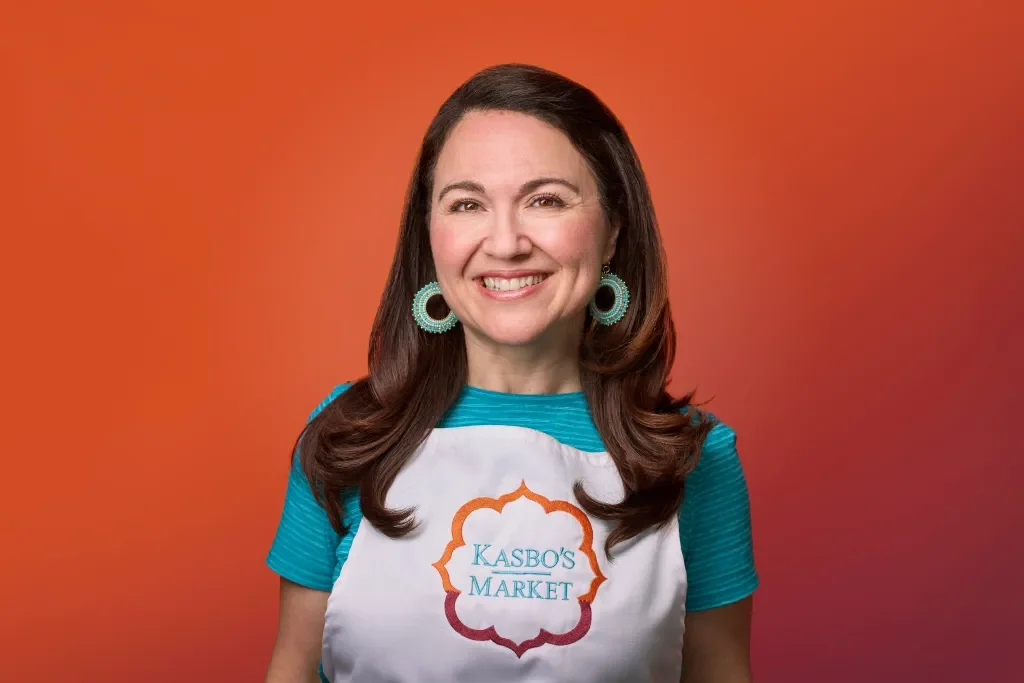
Benita Kasbo, Owner of Kasbo’s Market
Photo credit: Robin and Sue Photography
In late summer, the St. Lucie cherry tree fruits. Fragrant flowers perfume the air in spring, and the cherries that follow are tiny and too bitter to eat. Neither is what people value. The prize is the kernel nestled in the stony pit.
Extracted, dried, and ground, the kernel becomes mahleb, redolent of bitter almond, cherry, and something floral. It’s the smell of home and holidays and cheese.
Jibneh, the Middle Eastern cheese Benita Kasbo crafts in New Jersey and sells throughout the Northeast US, is mild, salty, and spiced with mahleb. Born in Aleppo, Syria, Benita and her family immigrated to the United States when she was two years old. She learned the taste of her birthplace and the traditional craft of cheesemaking at her family’s table in New Jersey, where jibneh was handmade at home. And it was at that same kitchen table where she learned Arabic, or lisān, meaning both language and tongue. Words and flavor lived in tandem while “eating jibneh with watermelon and cantaloupe in the summertime.”
The table
Food and language tie us to home and can set us apart. In 2017, she saw a call for an Arabic speaker to volunteer at refugee dinners in her community. Newly resettled families would invite their new community into their homes, into their kitchen, share the food they knew and had always served, and in that found a new belonging. Benita translated between the cooks and their guests, returning again to a table where language and flavor blended into a new story, one she now fostered between strangers building a new community together.
The recognition

Mahleb, the spice made from ground cherry kernels.
Photo credit: Robin and Sue Photography
In 2020, Benita further connected her Middle Eastern and American spheres beyond her language but now, this time, through her own food. In the midst of the covid pandemic, a local cheese store, one of the first vendors to sell Kasbo’s Market cheese, posted videos of cheesemakers telling the stories of their products. Benita submitted a video, and her jibneh gained traction. People who watched said, “Oh! That’s the cheese.” They recognized her from the refugee dinners. They knew her, her face and her words. And the cheese reminded them of the community they were kept apart from during a national and cultural crisis.
She has two kinds of customers. They matter equally but in different ways.
When she introduced her cheese, “many assumed it was for a Middle Eastern consumer only,” but Benita was always reaching for a broader American audience. They tell her, “Oh my God, this is delicious,” and it fills her cup.
A smaller group, mainly Middle Eastern customers, tell her it tastes like they’re back home. And that one overwhelms her. They ask how she knows how home tastes. “I don’t know how I know,” she says. “I just learned.”
The mentor she built
The beauty and loneliness in trying to articulate the complex vision of a growing venture bubbles to the surface. It’s hard to explain to anyone standing outside her vision. It can feel “very, very alone.” To Benita, the first person with whom you have your business is yourself. Kasbo’s Market existed first in her mind while on the road, driving from meeting to meeting at her old job. During that time she determined that a single prescriptive guide would narrow her path. “You can build your own mentor,” says Benita. And so she does, learning from videos, books, articles, trainings, and anything else she can find.
In her self-mentorship program, Benita pursued formal training in cheesemaking. She was accepted into the Dairy Runway cheesemaking program at Cornell, where the whole dairy industry opened up in front of her. In the summer of 2025, the Northeast Dairy Business Innovation Center awarded Benita a co-packing grant of nearly $77,000 bringing funding not just for cheese, but for marketing, packaging and a website. It was an enormous opportunity to stretch her operations but also brought complex emotions. For the first time, she had to share her vision and timeline with someone else, and was to be held accountable to a third-party. A grant brings a promise from both parties, grantor and grantee. “If I don’t perform, then I’m breaking my promise,” says Benita.
A place of her own

Jibneh, a mild, salty, and semi-firm cheese.
Photo credit: Robin and Sue Photography
That grant afforded Benita a new relationship with a co-packer in a symbiotic collaborative relationship. Benita is able to expand production of jibneh. which enables her co-packer to carry the cost of the facility and his crew. Together, their combined expanded volume widens how much local milk they can both bring in for their projects.
A facility does more than hold equipment. It is where a farmer’s milk becomes cheese. Each batch carries more of both stories into the world, from both local farmers and her heritage. “The milk connects to the cheese and then that cheese tastes like somewhere else.” From local milk to farflung tastes. From New Jersey to Syria and back. The more she can make, the farther her stories can travel, and the more people hear and taste of another place..
Stories travel through the tongue - through language and food. “I’m not just going to sell cheese,” says Benita. It’s going to be “way more,” and it will go “beyond dairy into other Syrian categories”, Middle Eastern, and more. She has a bigger dream for her business, for its direction, for what it will do for her family, for what it will do for her homes - in the Northeast United States and in the Middle East.
What this teaches us
The usual measures of economic development count jobs, revenue, and survival. None of them could see any of this: a dinner turning into a customer, a grant turning into a co-packer and a rebrand at once.
A dinner table. A shop’s Instagram feed. A cohort of dairy entrepreneurs at Cornell. A co-packer’s floor. Each place was a collision, a place where people bounced off each other to create something new. One collision is a moment. Multiple collisions generate energy, movement, and vibrancy.
A St. Lucie cherry tree is slow to grow. It takes years to mature, and its harvest is brief. But the flavor was inside the stone all along, and Benita found it. With enough time and enough trees, one plant becomes a grove, producing kernel after kernel.
Follow Benita’s path and you will find a grove growing beyond her kernel. Each seed planted opened a route to the next point. Each wild, blossoming tree was grown because Benita was already carrying the kernel ready to plant. The language she shared with a stranger bloomed into neighbors understanding each other. The cheese she was already selling flourished into reminders of a homeland and fresh growth in a new one. The promise of the grant produced fruitful relationships with farmers and makers.
This is why, often, the best help is found in an exchange, in collaboration, rather than prescriptive guidance. An advisor who hands you a predetermined path knows only the way they got there. The work has no map. But when you let yourself sink into the uncertainty - willingly - time and time again, testing and testing you will find the kernels ready to grow. You slowly find your way, because what you are making, and what Benita is making, can only show itself while it’s being made.
